Nicholas Stilwell and the US line
Most US Stilwells are able to trace their lineage back to Nicholas Stilwell. The history of Nicholas, after he came to Virginia, has been very well researched in the US, and I do not intend adding anything to that. However, there is still doubt and controversy over who Nicholas was and exactly where he came from. DNA research on both sides of the Atlantic has uncovered surprising results that throw more mystery on who exactly John was.
Before covering the known facts, we need to know what research was done before the DNA results were known. Until recent detailed research, most Stilwells based their assumptions on two publications. The first is a “History of the Stilwell family” by New Yorker, John E Stilwell MD, published in the 1920s. For a document of that period, the contents are the result of painstaking and excellent research. The details of the UK Stilwells are accurate and based on fact, and where there is no fact to back-up a conclusion, the author makes that clear.
The second is a “History of the Stilwells” by Benjamin Marshall Stilwell published in New York in 1876. Whilst the details of the American Stilwell family are probably accurate, the details of the UK Stilwells are inaccurate and not based on any facts that stand up to historical research. I strongly recommend that any researcher ignore this publication when attempting to trace Nicholas to the UK. The image to the right is from a copy of his book owned by the head of the Thursley Stilwells. The comments are scathing.

Excellent research by Greg Stilwell from PA has established many details about Nicholas that stand up to any investigation:
- He would have been born before 1617.
- He was in Virginia by 1634, with some evidence pointing to as early as 1622.
- There is no record of his purchasing a passage from England to Virginia and so it is believed he worked his passage or travelled as a servant for a wealthy family.
- He was established as a tobacco viewer by 1639.
- On 8th Oct 1642, he was issued “200 acres on the north side of the Charles River beginning at a small creek that issueth northernmost branch of Leverne called Fosbury Creek” (actual size was 202 acres). This issue was as reward for the sponsorship of 4 immigrants from England (names unknown) under the Headright scheme.
- He is likely to have been married by 1642, and maybe as early as 1635
- By 1645 he had a house and plantation “to the easter side of West Creeke”. He was recording his name by this time with the title “Lieft” (Lieutenant).
- By the end of 1646 he was in New Amsterdam following the well-documented Claiborne incident.
To add to the above, a number of suppositions have been made:
- As a Lieutenant (a term used locally for both a militia Sergeant and an estate manager) he would need to have been handy with a musket
- He would have learnt his tobacco skills in the period between arriving and becoming a viewer
- He sounded like a strong person – both physically and mentally
- Any wealth he had, he made in Virginia
Now we have some facts and some good suppositions, let us try and establish where he came from.
The name Nicholas was not that common in England at the time. The Dorking family did use the name but ALL Dorking Nicholas’ born before 1617 are known to have married, lived and died in Dorking. The parish records for Dorking are particularly complete and accurate and a baptism for our Nicholas simply does not appear anywhere. So if he isn’t from Dorking where is he from?
There is another possibility. From the Headright records of Virginia, a John Chandler sponsored 30 people to come to Northumberland County in 1656 (note that Nicholas had moved to New Amsterdam by then). One of those 30 names is a Roger Stilwell. There are only 2 Roger Stilwells recorded in England that can be a match for this one and they are closely related. They are from a small village about 10 miles south of Thursley in Surrey. One of them had an older brother called Nicholas. Nothing is known about this Roger Stilwell, and he probably never actually made the sailing to VA. The small village where he came from is close to the main road between London and Portsmouth – the prime naval dockyard of the British Navy. Many a young country worker would have been attracted by the sailor’s romantic tales of the sea, when all else that lay ahead of that young man was hard work as an agricultural labourer. Roger’s older brother, Nicholas, was looking to be a very good match for “our” Nicholas but doubt has since crept in with a marriage record of a Nicholas close to that village at a time when “our” Nicholas would have been in New Amsterdam. There are two Nicholas Stilwell’s in this area of this village and the marriage may refer to the other one, but it does throw doubt on the theory that “our” Nicholas and this Nicholas are one and the same.
So far then we have had everyone believing that Nicholas came from Dorking. But there is no match in parish records and the family were doing very well out of the lumber industry at the time – so why go penniless to America? So maybe he came from this small village in Sussex, close to Thursley. Everything seems to fit except for this anomaly of a marriage of a Nicholas in Sussex, England.
One last fact to be aware of is that a Jasper Stilwell settled in Guilford, Connecticut in 1639 but died without a male heir (note the mis-spelling of Guilford – it should have been spelt Guildford, after the town of that name in Surrey). He came with money and owned a brick-built house in the centre of the town (a sure sign of wealth and status). Although we do not know for certain where he came from, the name Jasper is unique to the Dorking branch of the family. So if Nicholas came from Dorking, and the probability is that Jasper came from there too, why did the latter settle in CT, when his “cousin” Nicholas was doing so well for himself in VA?
So we have two possibilities for Nicholas, both with strong circumstantial evidence.
DNA tests carried out in USA and England threw up very unexpected results. Some US Stilwells have the British Stilwell family DNA signature (I-M253) and some have a completely different DNA signature (R-M269). This was unexpected. All those in USA who took part in the DNA project could trace their line back to Nicholas Stilwell. But the difference between them was the child of Nicholas who they descended from. The image below shows the results known so far.
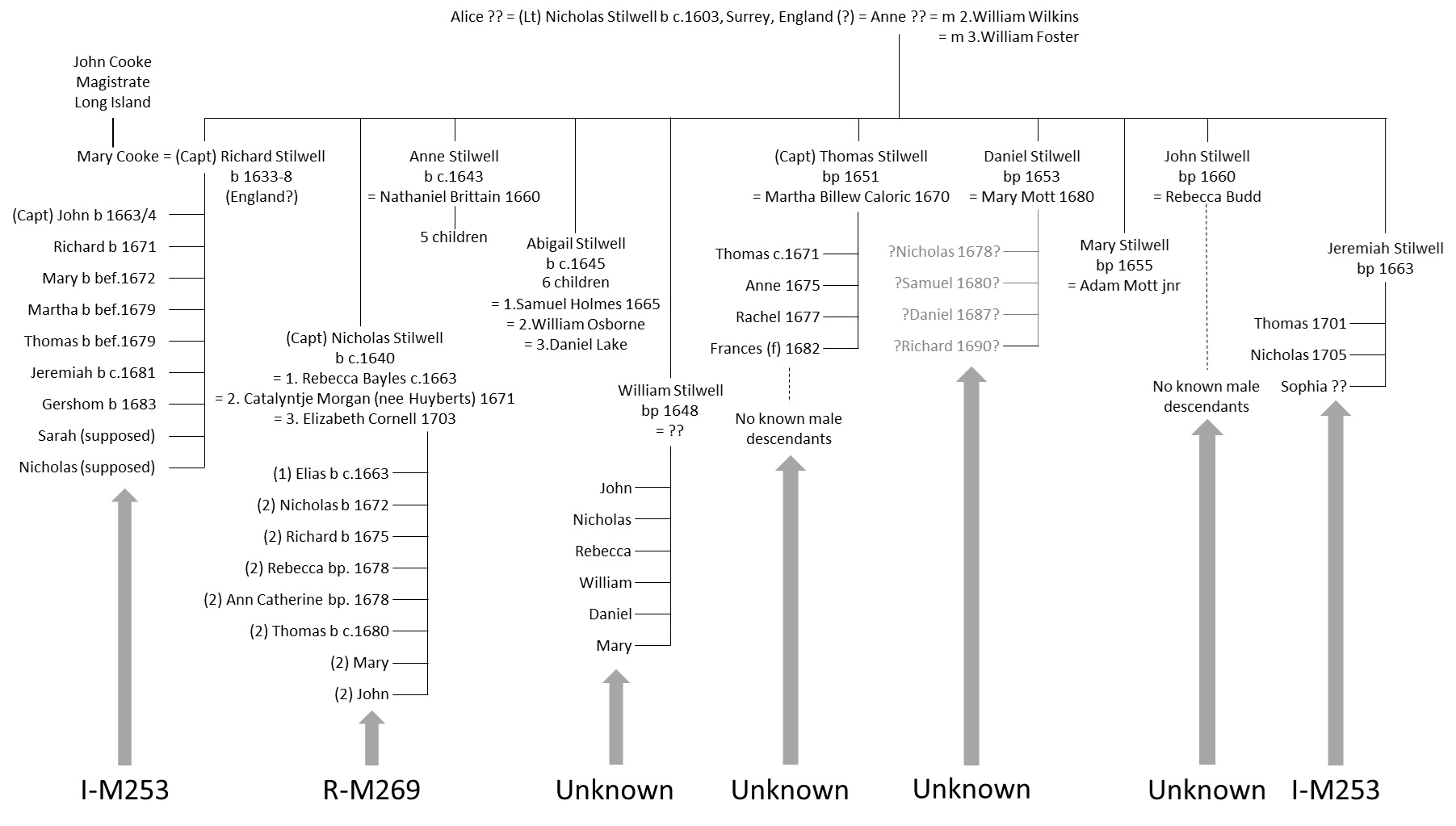
The results are so confusing that no conclusions can be drawn apart from the fact that two sons at least, can trace their line back to the British Stilwells; one (Capt Nicholas) cannot. The 4 “unknown” lines are because no present-day Stilwells have been identified who can trace their family line back to those 4 children of Nicholas snr. If you have any serious contributions to the history of the US Stilwells, in particular about Nicholas and his descendants, or about the history of early settlers in Virginia in general, contact Greg Stilwell – gregorystilwell125@gmail.com.
 Stilwell/Stillwell/Stillaway Genealogy